Brass vs Bronze vs Cast Aluminum Address Plaques: How to Choose the Right Metal
Written by: AeroSignage GlobalReviewed by: AeroSignage Editorial TeamPublished:Updated:
Brass, bronze, and cast aluminum address plaques differ mainly in patina behavior, weight, weathering, and cost structure. Solid brass and bronze offer authentic copper-alloy aging at roughly three times aluminum's weight, while CNC-carved aluminum with brass-effect or aged bronze finishes delivers the same visual language with easier mounting, lighter shipping, and more flexible per-address customization.
Brass, bronze, and aluminum age differently outdoors — the right choice balances patina, weight, mounting, and finishing cost.
1. What is the real difference between brass, bronze, and cast aluminum address plaques?
Brass, bronze, and cast aluminum are the three metals most US buyers compare when specifying an address plaque, and the differences start with the alloy itself. Brass is a copper-zinc alloy with a warm yellow-gold color; bronze is a copper-tin alloy that reads deeper and browner; aluminum is a light silvery metal that is almost always delivered with a painted, powder-coated, or otherwise finished surface rather than bare. Because all three can carry raised numbers, decorative borders, and textured backgrounds, product photos often look similar online. The practical differences show up later: how the surface ages, how much the plaque weighs on the wall or post, how it handles rain and coastal air, and how the cost builds up between raw material and finishing labor. This guide compares those factors so a buyer can specify the right metal instead of the most familiar name.
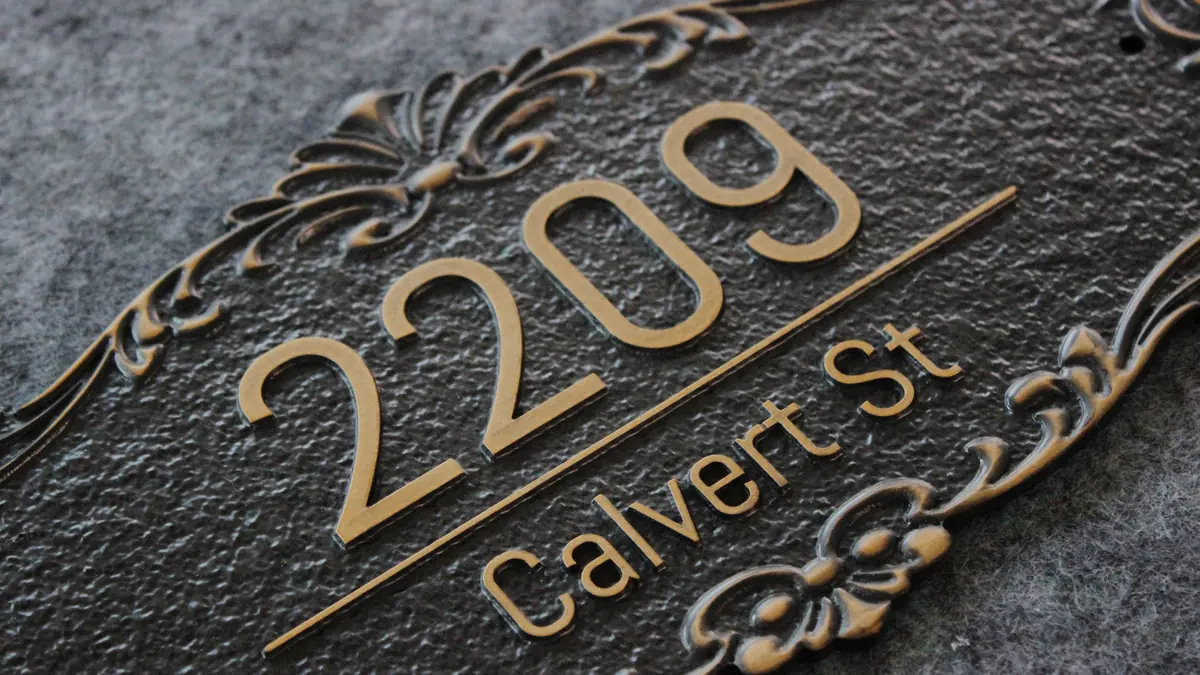
It also helps to separate the metal from the manufacturing route, because buyers often merge the two. Cast aluminum usually describes a plaque poured into a mold, while brass and bronze plaques may be cast, machined, or fabricated from plate. A fourth route matters for modern sourcing: CNC-carved aluminum, which starts from flat aluminum plate, mills raised borders, recessed backgrounds, and dimensional numbers from a production file, and then receives brass-effect, aged bronze, or antique copper finishing. When a buyer searches for brass vs bronze address plaque comparisons, the real decision is often authentic copper alloy versus copper-alloy appearance, and that framing changes the weight, mounting, shipping, and cost answers in the rest of this comparison. Stating the preference clearly in the first RFQ message prevents suppliers from quoting different assumptions against the same reference photo.
2. How does each metal look on day one, and how does the patina change over time?
Solid brass starts bright: a polished yellow-gold surface that reads almost jewelry-like against dark stone or painted wood. Left unlacquered outdoors, brass tarnishes within months, moving from bright gold through amber toward mottled brown as the copper in the alloy oxidizes. Some owners want exactly that lived-in look; others expect the day-one shine to last. If shine is the goal, the plaque needs a clear protective coating, and that coating becomes the maintenance item, because it eventually breaks down under UV and rain and must be renewed. Buyers specifying brass should state which stage of the metal's life they actually want on the wall: polished and sealed, softly aged satin, or fully darkened antique. That single sentence in the RFQ changes the finishing steps, the maintenance plan, and how the plaque will photograph a year after installation.
Solid bronze ages more predictably, which is one reason it dominates memorial and institutional plaques. It typically starts as a warm brown metal, darkens over the first years, and in wet or coastal exposure can slowly develop the blue-green verdigris associated with old statues and roof copper. The patina is not damage; it is a stable oxide layer that protects the metal underneath, which is why very old bronze plaques survive outdoors. The design consequence is contrast: as the background darkens, raised letters that are periodically cleaned stay brighter, deepening the relief effect over time. Buyers who want the darkened background and bright raised numbers on day one usually order an oxidized and relieved finish, where the dark patina is applied chemically and the letter faces are polished back before shipping.
Aluminum does not develop the natural patina of a copper-alloy plaque. Its decorative appearance depends on the selected paint, powder coating, oxidation treatment, or applied antique effect. Approving a black-and-gold or aged-copper sample defines the initial appearance, not a promise that the finish will remain unchanged for years. Sunlight, moisture, salt exposure, surface preparation, coating specification, and cleaning can affect color and gloss over time. Buyers should specify the exposure and agree on the finish system and care instructions. Red, yellow, or blue-green antique copper effects can be applied during production, but their protection and maintenance still need project-specific review.
3. What do the weight differences mean for mounting, posts, and shipping?
The density gap is the most concrete difference between these metals. Brass and bronze both sit around three times the density of aluminum, so the same plaque at the same thickness weighs roughly three times as much in solid copper alloy as it does in aluminum. On a masonry wall with proper anchors, either weight is manageable. The calculation changes on weaker substrates: vinyl or fiber-cement siding, hollow stucco walls, wooden gates, and especially mailbox posts, where a heavy plaque adds constant load and leverage on a small structure. A heavier plaque also demands mechanical fastening; an adhesive-assisted mounting plan that can support a thin aluminum plate is not a responsible plan for solid bronze. Buyers should confirm the mounting surface before choosing the metal, because the wall often makes the decision before aesthetics do.
Weight also compounds through logistics, which matters for imported custom plaques. International freight is priced against weight and volume, so a solid brass or bronze order carries more shipping cost per unit than the same design in aluminum, and heavy plaques need more protective packing so raised borders and polished faces are not damaged by their own mass in transit. For a single villa entrance plaque this is a minor line item; for a sign shop or developer ordering dozens of personalized plaques across a season, the accumulated weight difference becomes a real part of landed cost. None of this makes solid metal wrong. It means weight should be treated as a specification with consequences for anchors, installer time, packing, and freight, not as a free byproduct of choosing a prestigious material name.
4. Which metal weathers best outdoors, including coastal and high-rain exposure?
None of the three metals rusts, because none of them is iron-based, so the outdoor question is really about how each surface changes and what protects it. Bronze is the long-service benchmark: its patina is self-protecting, and the metal tolerates decades of rain, sun, and freeze cycles with the main change being color. Brass is similarly corrosion-resistant in normal exterior use, but its appearance is less stable; unlacquered brass streaks and darkens unevenly where water runs, and lacquered brass depends on the coating surviving UV exposure. Aluminum resists general corrosion well through its own oxide layer, and properly prepared painted or coated aluminum is a proven exterior product across the residential address plaque market. Its weak points are finish damage from impact and, in unprotected form, pitting under prolonged salt spray.
Coastal projects deserve a separate finish and mounting review. Record distance from the sea, rain and sun orientation, salt spray, and irrigation exposure. Aluminum coatings need suitable preparation and protection at edges and fixings; a damaged coating can leave the substrate exposed. Fasteners must be selected for the plaque metal and environment. Specifying stainless steel alone does not eliminate galvanic corrosion when dissimilar metals are electrically connected in wet conditions. The mounting design may require electrical isolation, compatible washers or gaskets, and drainage, to be confirmed by the installer or project professional. Also state whether natural surface change is desired or whether a controlled appearance with a maintained protective coating is the goal.
5. How should buyers compare cost: raw material, tooling, and finishing labor?
There is no honest fixed price for a custom address plaque, but the cost structure of each metal is predictable. Solid brass and bronze concentrate cost in the material itself, because copper alloys are priced well above aluminum per kilogram and the plaque uses roughly three times the weight for the same volume. On top of the metal, casting requires pattern or mold work, machining solid copper alloy consumes more tool time, and hand finishing, oxidizing, and polishing add skilled labor to every unit. Quantity helps less than buyers expect, since material weight scales linearly with every additional plaque, so the per-unit floor stays high even in volume. Solid metal makes economic sense when authenticity is genuinely part of the design value, most often on a single feature plaque rather than across an entire property.
Cast and CNC-carved aluminum move the cost away from material and into process. The aluminum plate itself is a small share of the price; the drivers are CNC programming and machine time, relief depth, the number of finishing steps, and packing. A flat engraved plate with one paint color is the baseline, while a raised border, textured background, dimensional numbers, and a multi-step antique copper finish with polished highlights each add labor. That structure rewards customization: changing the address text, plaque size, or border on an aluminum route is a file change, while changing a cast bronze design can reopen pattern work. When comparing quotes across metals, buyers should normalize the specification first, meaning the same size, thickness, relief depth, finish steps, and packing, because a cheaper number usually describes a thinner or simpler plaque rather than a better supplier.
6. Can CNC-carved aluminum really deliver a brass or bronze look without the weight?
Yes, when finishing is treated as a controlled production step rather than a spray-paint shortcut. AeroSignage, the official international sales and service office for an affiliated signage manufacturing base, produces brass-effect and bronze-look plaques by CNC-carving flat aluminum plate into raised numbers, decorative borders, and textured backgrounds, then building the metal character through finishing: aged copper treatments in red antique copper, yellow antique copper, and blue-green antique copper directions, black-gold combinations, brushed and polished highlights, and sealed topcoats for exterior use. The manufacturing base uses CNC engraving and relief-carving equipment together with controlled finishing, so the carved depth that makes a plaque read as cast metal, meaning shadow lines, rounded numeral faces, and recessed background fields, comes from the toolpath file rather than from a printed texture.
The buyer's job is to specify the effect precisely, because the words brass and bronze are ambiguous in a quote request. A production-ready specification distinguishes between solid brass or bronze, plated metal, metallic paint, and an antique effect finish on carved aluminum, and it attaches a reference photo or sample target for the exact tone: bright polished brass, soft satin brass, oil-rubbed bronze style, or a green-tinged aged copper. It should also state where highlights belong, for example polished numeral faces over a darkened background, since that contrast is what makes an effect finish convincing at the door. AeroSignage supports this with finish sample boards and close-up photos during quotation review, and for larger programs a physical sample plaque in the target size and finish is the reliable way to approve the effect before an entire order is produced.
7. Which metal fits villa entrances, mailbox posts, and commercial facades, and what should the RFQ include?
Villa entrances reward visual weight and decorative depth, and they usually offer a masonry wall or gate pillar that can carry any of the three metals. A solid bronze or brass plaque is defensible here as the single feature piece of the property, especially where the owner wants natural aging. Just as often, a CNC-carved aluminum plaque with deep relief, an aged copper or black-gold finish, and polished raised numbers achieves the architectural effect while keeping budget available for size, which matters because entrance plaques are read from the street and legibility grows with scale. Mailbox posts sit at the other extreme: the structure is small, the plaque hangs or bolts onto limited material, and wind adds load, so lighter aluminum construction with a durable exterior finish is the practical default, with solid metal reserved for posts engineered to carry it.
Commercial facades sit in between and add procurement logic. Storefronts, offices, and multi-building properties often need a family of related signs in different sizes, want replaceability when tenants or numbers change, and mount at heights where installer time and anchoring are cost items, all of which favors file-driven aluminum production, while a cast bronze piece can still anchor the main entrance where the property wants institutional permanence. One boundary matters in the United States: the plaques discussed here are decorative custom signage, and signage that identifies rooms or serves accessibility functions carries local tactile, braille, and contrast requirements that the buyer must confirm with order-specific documents and local consultants. Many properties pair a decorative facade plaque with separately specified compliant identification signage; AeroSignage can produce buyer-specified tactile elements but does not certify compliance.
A production-ready RFQ closes the comparison faster than any article can. It should include: the plaque size, shape, and thickness target; the address text, street name, or name list with quantities; whether the buyer requires solid brass or bronze or accepts a brass-effect or bronze-look finish on carved aluminum; a finish reference photo or sample target with notes on where polished highlights belong; relief expectations such as raised numbers, border style, and background texture; the mounting surface, exposure context, and hardware preference; artwork files in editable vector format where available; and packing or labeling requirements for multi-plaque orders. With those details in one message, AeroSignage can review the production route, confirm feasibility, and return a quotation built on the same specification the buyer will actually install.
Decision Factor
Solid Brass
Solid Bronze
Cast / CNC-Carved Aluminum
Appearance on day one
Bright yellow-gold, polished or satin
Warm brown metal with deeper tone
Finish-defined: black-gold, antique copper, painted color
Patina over time
Tarnishes toward amber and brown unless sealed
Darkens, can develop protective green verdigris
Applied decorative finish; color and gloss can change with exposure and care
Weight and mounting
Heavy; needs mechanical anchors
Heaviest feel; masonry-grade mounting
Roughly one third the weight; suits siding, posts, large sizes
Weather resistance
Corrosion-resistant, but appearance is less stable outdoors
Benchmark exterior longevity; patina protects the metal
Oxide layer plus sealed coating; specify coastal exposure
Cost logic
Material-heavy; high per-unit floor
Material and tooling heavy; best for one feature piece
Machine time and finishing labor; customization is a file change
Best use
Polished entrance accents and covered entries
Heritage entrances and signature feature plaques
Villa plaque systems, mailbox posts, personalized and multi-unit orders
Key takeaways
Brass, bronze, and aluminum all survive outdoors; the real differences are patina behavior, weight, and where cost sits between raw material and finishing labor.
Solid brass and bronze weigh roughly three times as much as aluminum, which drives anchor choice, post loading, protective packing, and freight.
Brass and bronze can change naturally outdoors; aluminum relies on its specified decorative finish. None should be described as keeping an unchanged appearance without considering exposure, protection, and maintenance.
CNC-carved aluminum with aged copper, brass-effect, or black-gold finishing delivers the cast-metal look with lighter mounting and file-based customization.
Specify solid metal versus effect finish explicitly in the RFQ, and normalize size, thickness, relief depth, and finish steps before comparing quotes.
Sources and review scope
Supplier-specific statements use clearly identified first-party AeroSignage materials.
Local codes, accessibility requirements, engineering details, and order-specific claims must be confirmed for the destination market before production.
FAQ
Is bronze or cast aluminum better for an outdoor address plaque?
Both can be suitable when the material, finish, exposure, and mounting are specified together. Bronze may suit a feature entrance where solid metal and natural patina are desired. Cast or CNC-carved aluminum offers lower weight and finish flexibility for repeated villa or mailbox signs. Neither choice guarantees an unchanged appearance or a universal service life. Compare the actual finish system, maintenance requirements, substrate, and hardware rather than treating the metal name alone as a durability promise.
What is the difference between brass and bronze on an address plaque?
Brass is a copper-zinc alloy with a brighter yellow-gold color; bronze is a copper-tin alloy that reads browner and deeper. Outdoors, unlacquered brass tarnishes unevenly toward brown, while bronze darkens more predictably and can develop a stable green-tinged patina over years. Bronze is generally the lower-maintenance choice for natural aging; brass suits buyers who want a polished gold tone and accept coating renewal.
Can an aluminum plaque really look like brass or bronze?
Yes, when relief carving and finishing are controlled together. AeroSignage CNC-carves raised numbers, borders, and textures into aluminum plate, then applies brass-effect, black-gold, or aged copper finishes, including red, yellow, and blue-green antique copper directions, with polished highlights and a sealed topcoat. Buyers should attach a reference photo and approve a physical sample so the tone and highlight placement match expectations.
How much heavier is a solid brass or bronze plaque than aluminum?
Roughly three times heavier for the same size and thickness, because copper alloys are about three times as dense as aluminum. That affects the anchors required, whether siding or a mailbox post can carry the plaque safely, the protective packing needed, and international freight cost. Aluminum construction lets buyers increase plaque size or relief depth without the mounting and shipping penalties.
Do address plaques need to meet ADA or accessibility requirements?
The plaques discussed here are decorative custom signage. In the United States, signage that identifies permanent rooms or serves accessibility functions carries local tactile, braille, contrast, and mounting requirements that the buyer must confirm with order-specific documents and local consultants. Many properties pair a decorative plaque with separately specified compliant identification signage. AeroSignage can produce buyer-specified tactile elements but does not certify compliance.
What should I send to get an accurate address plaque quote?
Send the plaque size and thickness target, address text and quantities, whether solid brass or bronze is required or an effect finish on carved aluminum is acceptable, a finish reference photo, relief and border expectations, mounting surface and exposure context, editable artwork if available, and packing requirements. With a complete specification, quotation review can usually confirm the production route in one round.
Useful resources for quotation review
These resources connect the guide with AeroSignage product references, workshop processes, and the files needed for an accurate quotation.