Address Plaque Manufacturing Comparison / 9 min read
Cast Aluminum Address Plaques vs CNC-Carved Aluminum: Which Works Better for Personalized House Numbers?
Written by: AeroSignage GlobalReviewed by: AeroSignage Editorial TeamPublished:Updated: No later material update recorded
Cast aluminum address plaques are strong for repeated standard designs, but CNC-carved aluminum is often the more flexible route for personalized house numbers, street names, phone numbers, and one-off customer orders.
Personalized address plaques need a production route that supports different house numbers, street names, finishes, and mounting contexts.
1. Start with the order pattern, not the material name
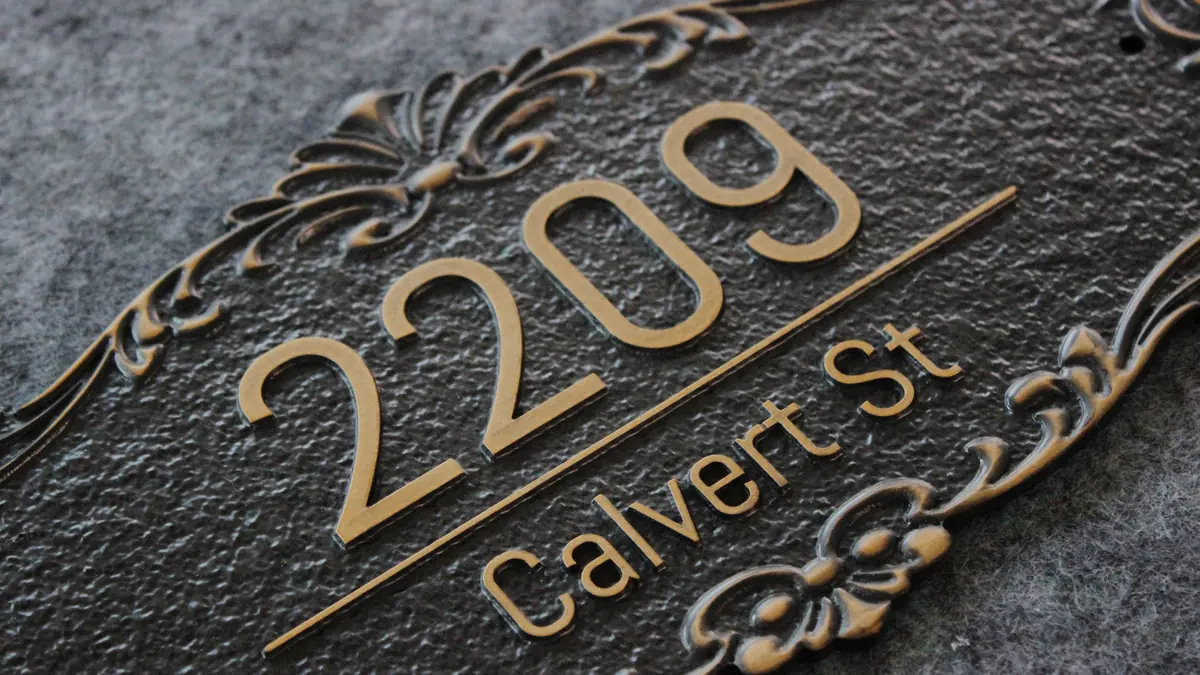
A buyer asking for cast aluminum address plaques may be describing a familiar look: a dark textured background, raised gold numbers, a shaped border, and a durable outdoor plaque. That does not always mean every personalized plaque must be produced by a full one-piece casting route.
For a supplier serving many end customers, the real production question is whether the orders repeat the same base design or whether each plaque changes by address, street name, phone number, size, and finish. Repeat orders and one-off personalized orders behave very differently in manufacturing.
2. Where traditional cast aluminum is strongest
Casting is a good fit when the same plaque body, border, texture, and layout repeat many times. A stable mold can spread setup cost across a larger volume, and the result can feel heavy and traditional.
This is why many classic residential plaque catalogs use standard shapes and repeated patterns. The customer chooses the text or number inside a design family, while the supplier keeps the underlying product structure highly repeatable.
3. Why CNC-carved aluminum can be better for personalized plaques
CNC-carved aluminum starts from flat material. The carving path then creates raised borders, recessed backgrounds, textured fields, dimensional numbers, and custom letter forms layer by layer. The important advantage is that the carving effect is controlled by the file.
For personalized house numbers, that file-based route can reduce mold pressure, shorten design iteration, and make different address layouts easier to quote. If every buyer has a different number, street name, phone number, size, or mounting condition, CNC often gives better customization control than one-piece casting.
4. The cast-aluminum look can be built without copying a catalog design
Many customers like the cast aluminum look because of the contrast: black or bronze textured background, raised metallic numbers, shaped outline, and classic border. A CNC route can create a similar premium design language while keeping the artwork, size, text, and finish flexible.
Reference catalogs and buyer photos are useful for discussing shape, proportion, and market expectations. They should not be copied exactly when a design is protected or belongs to another brand. A better approach is to create an original AeroSignage version with the same functional purpose: legible raised numbers, outdoor-ready appearance, and customizable text.
5. Modular numbers change the supplier model
A useful product route is a modular plaque system: the base plaque, border, background texture, and finish can be standardized, while numbers or letters are produced as separate components and assembled according to each customer's address.
This matters for ongoing suppliers because orders may be single items per end customer. A modular number system can support different digit combinations, replacement logic, and faster personalization without treating every order as a completely new casting project.
6. How to quote this type of product responsibly
A reliable quote should separate the base plaque, number system, surface finish, and installation method. Buyers should send the target size, address text, quantity pattern, finish reference, mounting surface, outdoor exposure, packaging requirement, and whether they need a sample before recurring orders.
For buyers who prefer cast aluminum, AeroSignage can discuss the desired look and production logic directly. In many cases, the practical recommendation is to test a CNC-carved aluminum sample first, then decide whether the appearance, cost, and customization workflow match the buyer's ongoing order model.
Decision Point
Traditional Cast Aluminum
CNC-Carved Aluminum
Best order type
Repeated standard plaque bodies and stable designs
Personalized house numbers, street names, phone numbers, and small custom batches
Setup logic
Mold investment makes sense when the design repeats
Toolpath and artwork changes are easier when each order differs
Design flexibility
Strong when shapes and layouts stay fixed
Strong when text, size, border, texture, or number combinations change
Visual result
Traditional weight and cast texture
Raised relief, textured backgrounds, polished accents, and cast-aluminum-style finishes
Supplier risk
Higher risk if the buyer needs many one-off variations
Better fit for sample testing, modular numbers, and ongoing personalized orders
Key takeaways
Cast aluminum is strongest when a plaque body and design repeat enough to justify mold work.
CNC-carved aluminum is often stronger for one-off personalized address plaques and changing layouts.
A cast-aluminum style can be achieved through CNC relief, textured backgrounds, raised numbers, and controlled finishing.
Modular detachable numbers make it easier to serve ongoing single-item orders with different addresses.
Reference catalogs are useful for market direction, but the final design should be original and production-ready.
Sources and review scope
Supplier-specific statements use clearly identified first-party AeroSignage materials.
Local codes, accessibility requirements, engineering details, and order-specific claims must be confirmed for the destination market before production.
FAQ
Can CNC-carved aluminum look similar to cast aluminum?
Yes. CNC relief, textured backgrounds, raised numbers, aged bronze or black-gold finishes, and polished accents can create a cast-aluminum-style appearance while keeping the design more flexible.
Is cast aluminum always made by casting?
If the part is truly cast aluminum, it uses a casting process. However, many buyers use the phrase to describe a visual style. CNC-carved aluminum can sometimes deliver the desired look with better flexibility for custom addresses.
Are modular numbers possible on address plaques?
Yes. Numbers and letters can be produced as separate components and assembled onto a base plaque. This is useful when each customer has a different address or phone number.
Can AeroSignage reproduce a plaque from a reference catalog?
Reference catalogs can guide size, function, proportion, and finish direction, but AeroSignage should create an original production design rather than copying a protected catalog design exactly.
What is the best first step for a new supplier relationship?
Start with one sample plaque using the buyer's target size, address format, finish reference, and mounting requirement. After the sample is approved, the same production logic can be used for ongoing personalized orders.
Useful resources for quotation review
These resources connect the guide with AeroSignage product references, workshop processes, and the files needed for an accurate quotation.