Villa Entrance Signage: Designing Number Signs and Address Plaques for Premium Residences
Written by: AeroSignage GlobalReviewed by: AeroSignage Editorial TeamPublished:Updated: No later material update recorded
Villa signage is a first-impression architectural element, not a generic house number. This guide shows how to design coordinated villa number signs, entrance plaques, and wall-mounted address markers that match premium architecture, stay legible from the gate, and last outdoors, and how single villas and multi-unit developments should specify materials, finishes, lighting, and mounting in one production-ready request.
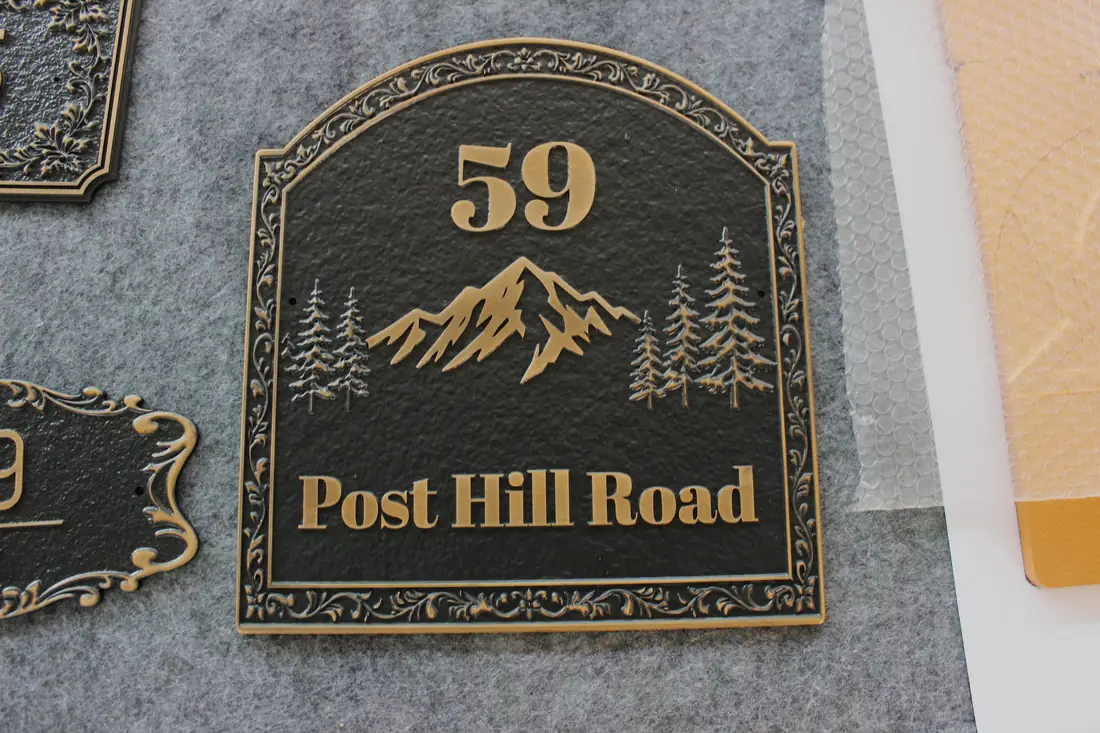
Villa signage works as a coordinated set: gate number, entrance plaque, and wall address marker sharing one finish language.
1. What makes villa signage different from a generic house number?
Villa signage does a job that a hardware-store house number cannot: it introduces the property before a visitor reaches the door. At a premium residence, the number sign at the gate or entrance wall is the first designed object a guest, buyer, or delivery driver sees, and it sets an expectation for everything behind it. A thin stamped plate on a stone villa reads as an afterthought, while a carved plaque with raised numerals and an aged metal finish reads as part of the architecture. This is why villa number signs are specified as decorative architectural elements rather than commodity address markers. The goal is not only to state the address but to carry the material language, weight, and craftsmanship the rest of the property promises, from the first glance at the gate.
The second difference is that villa signage has to match a specific building, not a generic wall. A modern concrete-and-glass villa, a Mediterranean stucco house, and a traditional stone estate each call for different plaque silhouettes, border treatments, numeral styles, and finish tones. A sign that ignores the architecture looks bought rather than designed, even when the individual piece is well made. AeroSignage supports this with CNC relief carving that lets border depth, background texture, and numeral profile be tuned to the property rather than pulled from a fixed catalog, plus aged copper, black-gold, brass-effect, and stone-look finishes that can echo the wall, gate, or trim. Matching the sign to the building is what turns an address into part of the entrance composition instead of a label attached to it.
The third difference is viewing distance. An interior room number is read from arm's length, but a villa number is often read from a car at the gate, from the road, or from across a forecourt, sometimes in poor light. That changes every design decision: numeral height, stroke weight, contrast against the background, and how far the sign sits from the approach. A plaque that looks balanced in a photograph can be unreadable from ten meters if the numbers are too fine or the background is too busy. Villa signage should therefore be designed around the real approach, measuring how far away the number must be legible and sizing the numerals to that distance first, then adding decorative border, texture, and finish around a number that already reads clearly from where visitors actually arrive.
2. How should villa number signs, entrance plaques, and wall-mounted address markers work as one system?
Premium villa entrances rarely rely on a single sign. A complete entrance often uses three coordinated elements: a villa number sign at the gate or pillar for quick identification, a larger entrance plaque that may carry the villa name, family name, or crest near the front door, and a wall-mounted address marker that states the street number for the road and access. Treating these as one family, rather than three separate purchases, is what makes an entrance feel designed. The most common mistake is buying a decorative name plaque from one source and a utility number from another, so the two clash in finish, scale, and quality. Planning them together lets the finish language, numeral style, and border treatment carry across all three so a visitor reads one coherent identity from road to door.
Coordination does not mean the three elements are identical; it means they are clearly related. A practical approach is to fix one finish direction, for example black-gold with polished raised numerals or a red antique copper patina, and one numeral style, then vary scale and construction by role. The gate number can be compact and bold for distance reading, the entrance plaque larger and more decorative with a carved border or crest, and the wall marker simpler but drawn from the same palette. AeroSignage can produce all three through the same CNC relief and finishing routes, which keeps the surface tone and depth consistent across pieces of different sizes. The villa signage application page shows how number signs, arched entrance plaques, and exterior address markers can share one visual language while each does its own job.
Because the elements share a design language, they should also share one specification. Ordering the gate number, entrance plaque, and address marker in a single request lets the supplier match finishes physically rather than by name, since an antique copper on one piece reads the same as on another only if they run through the same finishing batch. It also protects cost, because shared setups, shared finish trials, and shared artwork amortize across the group instead of being repeated for three separate orders. For a single luxury villa this might be three or four pieces; for a development it scales to dozens, but the principle holds: design the entrance signage as a set, quote it as a set, and the result reads as a set from the road to the front door.
3. Which materials and finishes survive outdoors and still look premium?
Outdoor villa signage lives in sun, rain, temperature swings, and sometimes salt air, so the material and finish have to be chosen for durability as much as looks. Aged copper finishes, in red, yellow, and blue-green antique copper directions, are popular for villa entrances because the patina reads as intentional age rather than wear, so the sign looks considered from the first day and continues to suit a mature landscape. Black-gold is another strong exterior choice: a dark textured background with polished or gold-toned raised numerals gives high contrast that stays legible in changing light, which matters at a gate. Both are decorative surface treatments, and the buyer should decide whether the finish is sealed with a clear protective coat or left to weather as a living patina, because that choice changes how the sign ages.
Material choice is often a balance between authenticity and practicality. Solid brass and copper offer genuine weight and natural aging, which can be worth it for a signature entrance plaque, but they add cost, weight, and handling that are hard to justify across many pieces. A brass-effect or aged-bronze finish on carved aluminum delivers much of the visual warmth while staying lighter, easier to mount on a pillar, and simpler to ship, which is why it is a common route for villa number signs. Stone-look surfaces and textured backgrounds suit villas where the sign should feel built into a masonry wall rather than applied to it. AeroSignage works across aluminum, brass-effect metal, stone-look surfaces, resin, and mixed constructions, so the same entrance can pair a solid-metal feature plaque with lighter matched number signs without breaking the finish language.
Whatever the finish, outdoor durability depends on details that belong in the specification, not left to chance. Fasteners should be stainless or properly coated so they do not rust and streak the wall or the plaque face; raised numerals and polished highlights are the most exposed points and benefit from protective packing and careful handling; and finishes exposed to coastal salt, irrigation overspray, or de-icing splash deserve a note in the order so the production review can recommend the right protection route. Routine care should be mild soap and water rather than abrasive pads or strong solvents, which cut through clear coats and patinas alike. A villa sign is a long-term fixture, so specifying the exposure conditions up front is what lets the finish still look intentional several seasons later rather than tired.
4. How do villa developers order a consistent system across a development versus a single luxury villa?
A single luxury villa and a multi-unit development are different buying problems that happen to use the same product family. For one villa, the priority is bespoke character: the owner wants a plaque that suits this house, this gate, and this landscape, so the order is small, highly customized, and often centered on one signature entrance plaque plus a matched number and address marker. Here the decorative ceiling is high and the quantity is low, which means richer relief, real brass or copper accents, or a custom crest are all reasonable because the cost lands on only a few pieces. The sensible process is to develop and approve one sample that captures the finish, depth, and numeral style, then produce the small set against it so the whole entrance reads as one commissioned piece.
A villa development inverts the priorities. Now consistency and repeatability matter more than one-off flourish, because dozens of villas must feel like one community while each still shows its own number. The efficient structure is to standardize one plaque construction, one finish direction, and one numeral style across all units, keeping the digits as the only variable, then reserve richer treatment for shared elements such as the development entrance sign, gatehouse, or amenity buildings. This is exactly where CNC relief production is strong: the same carving file and finish route repeat across every unit while the number changes, so setup and finish trials amortize across the run instead of being paid per villa. Developers should send the full unit schedule with the order, because the distribution of numbers affects material and production planning just as a hotel room list does.
Both models benefit from planning for the future at order time. Addresses change, plaques get damaged during construction or landscaping, and developments add phases, so the approved artwork, plaque dimensions, finish reference, and mounting pattern should be saved as a reorder package and kept on file with the supplier. For a development, standardizing one plaque back, one hole pattern, and one hardware kit turns each new phase into a numeral change rather than a fresh design exercise. For a single villa, the saved sample and files mean a damaged numeral can be reproduced without recarving the whole plaque. AeroSignage keeps quotations and production tied to its official international sales and service office, so a developer or homeowner works with one export-facing contact for the first order and every reorder that follows, which keeps a multi-phase project visually consistent over years.
5. How do you keep the villa number legible from the gate, day and night?
Legibility at a villa gate is a function of numeral size, stroke weight, and contrast measured against the real viewing distance, not against how the sign looks in the hand. As a rough design guide, numerals should grow with the distance from which they must be read, so a number identified from a car at the road needs to be considerably larger and bolder than one read from the front step. Raised numerals help more than any single decorative choice, because they cast their own shadow line and stay readable as daylight shifts; a light polished or gold-toned number over a dark textured background is a proven high-contrast combination for exactly this reason. A busy background or overly fine lettering is the fastest way to lose a number outdoors, so the decorative border and texture should be built around a numeral that already reads clearly.
Lighting extends that legibility into the evening, when a villa entrance is often at its least visible and most used. There are two broad routes. External lighting keeps the sign itself simple and lights it from a fixture on the pillar, wall, or landscape, which suits aged and patinated finishes that look best under warm light rather than through it. Integrated or backlit signage builds illumination into the plaque or numerals for a modern, self-lit look, and it changes the order: it adds LED components, internal structure, wiring provisions, and function testing, plus downstream power routing and a maintenance plan the sign quote never shows. Many villa projects light only the primary gate or entrance number and leave secondary markers unlit. Any lighting intention should be stated in the first request, including where power is available, so the design is engineered for it rather than retrofitted.
Placement finishes the legibility question. A villa number should sit where a visitor's eye naturally lands on the approach, typically the gate pillar, the entrance wall beside the drive, or the wall next to the front door, and at a height that stays in the sightline rather than below a car window or above a headlight beam. It is worth walking and driving the actual approach before fixing the position, because gateposts, planting, shadows, and the angle of the drive hide more villa numbers than any finish decision does. Where a villa sits far back from the road, a simple number at the driveway entrance can serve the street while the decorative plaque serves the entrance itself. The two roles do not have to be carried by one sign, and separating them often improves both.
6. How do you mount villa signage on stone, stucco, and gate pillars?
Mounting is where a beautiful villa plaque succeeds or fails, and the surface dictates the method. Natural stone, common on premium villa walls and pillars, rewards patience: cut stone and dense fieldstone drill much like hard masonry with quality bits, steady pressure, and correctly sized anchors, while on irregular stone the mortar joints are often the more practical drilling target. Hidden studs set in masonry epoxy are a favored route for stone villa entrances because the plaque face stays uninterrupted against the stone, which is exactly the clean look a premium wall wants. On rough or dusty faces, a combined approach works best, with mechanical pins or studs carrying the weight and a bead of exterior adhesive stabilizing the plaque against rocking. Adhesive alone across an irregular, porous stone surface is the classic failure, because the real contact area is far smaller than it looks.
Stucco, common on Mediterranean and contemporary villas, is a brittle cementitious shell that cracks when it is treated like solid masonry. The safer sequence is to pre-drill through the stucco layer with a masonry bit at low speed, without hammer action, and reach a fastener into the structure behind the shell rather than relying on the stucco to hold threads. Every penetration is a potential moisture path, so each hole should be sealed with a quality exterior sealant before the screw or stud goes in, and a modest standoff behind the plaque lets rain drain instead of sitting against the wall. Because stucco holds point loads poorly, heavier relief plaques should spread their weight across enough fixings rather than hang from one or two. A buyer who names stucco in the order lets the production review position holes, studs, and standoffs for sealed, well-distributed mounting.
Gate pillars bring their own considerations because they are often the primary location for a villa number and are usually masonry, stone-clad, or rendered. The pillar face may be narrow, so the plaque size and hole pattern must be planned to sit centered and level within the available width, and the mounting should account for a surface more exposed to weather and passing traffic than a sheltered entrance wall. Deciding the mounting route before production matters here more than anywhere, because drilling a finished aged-copper or black-gold surface in the field risks chipping the coating around each hole, and pillars rarely offer a second chance to reposition cleanly. AeroSignage can program hole positions or stud layouts alongside the CNC carving file and pack a drilling template and matched hardware with the plaque, so a pillar-mounted villa sign arrives ready to install straight and sealed rather than improvised on a ladder.
7. What should a production-ready villa signage RFQ include?
Villa signage projects move fastest when the request treats the sign and its installation as one system from the start. A production-ready RFQ collapses several rounds of back-and-forth into one review cycle and returns a quote that is accurate and comparable rather than a guess built on assumptions. The single most useful habit is to specify rather than describe: instead of asking for a nice bronze villa number, state the material route, the finish reference, the numeral height tied to viewing distance, and the wall the sign will mount on. For a development, the equivalent is sending the full unit schedule so the supplier can plan the repeated construction and the changing digits together. The clearer the specification, the less the project depends on interpretation, and the closer the delivered sign lands to the picture in the buyer's head.
A complete villa signage RFQ should include: the entrance elements needed, whether a gate number, an entrance or name plaque, a wall-mounted address marker, or the full set; exact dimensions with width, height, and thickness for each element, and numeral height sized to the viewing distance from gate or road; the quantity, with a full unit schedule for a development or the specific pieces for a single villa; the material route, stating whether solid brass or copper is required or a brass-effect, aged copper, black-gold, or stone-look finish on aluminum is acceptable; a finish reference photo, sample, or color target with a note on acceptable variation; the mounting surface for each piece, whether stone, stucco, rendered or masonry pillar, or entrance wall, ideally with a photo; any lighting intention with the location of available power; artwork files in vector formats where possible; and the packaging requirement, including protection for raised numerals.
One more line protects US buyers specifically. AeroSignage produces decorative custom villa signage; where a plaque also serves as identification signage, US properties can carry local tactile, braille, and contrast requirements that the buyer must confirm with order-specific documents and local consultants, and many properties pair a decorative plaque with separately specified compliant identification signage. AeroSignage can produce buyer-specified tactile elements but does not certify compliance. With the exposure conditions, mounting surface, and finish protection named in the same request, the production review can treat the villa entrance as a complete decorative system, engineer the mounting rather than improvise it, and save the approved artwork, dimensions, finish reference, and hole pattern as a reorder package so future phases or replacements match the original. That is the difference between a one-time purchase and a villa signage program that stays consistent for years.
Villa Signage Element
Typical Placement
Recommended Material / Finish
Sizing and Legibility Note
Gate number sign
Gate pillar or entrance wall at the road
Brass-effect or aged copper on carved aluminum; black-gold for high contrast
Largest numerals in the set, sized for reading from a car at the gate or road
Entrance or name plaque
Wall beside the front door or forecourt
Solid brass or copper for a signature piece, or matched brass-effect aluminum with carved border or crest
Read at closer range, so scale for decorative detail rather than maximum distance
Wall-mounted address marker
Front wall facing the street for road and access visibility
Aged copper, black-gold, or stone-look to match the set, sealed for exposure
Numeral height and contrast set by street viewing distance, not by plaque size
Development entrance sign
Community gate, gatehouse, or boundary wall
Heavier relief or solid-metal accents to signal arrival, matched to unit finish
Larger than any single-unit sign; readable from a moving vehicle
Driveway or secondary number
Driveway entrance where the villa sits back from the road
Simple durable finish from the same palette; lighter aluminum construction
Bold, plain numerals prioritizing legibility over ornament
Key takeaways
Villa signage is a first-impression architectural element, so it should match the building and read clearly from the gate or road, not just state a number.
Design the gate number, entrance plaque, and wall address marker as one coordinated set with a shared finish, numeral style, and specification.
Choose finishes for outdoor durability as well as looks: aged copper, black-gold, brass-effect on aluminum, and stone-look each suit villa exposure when protection is specified.
A single luxury villa justifies bespoke relief and solid-metal accents, while a development should standardize one construction and vary only the digits.
Decide the mounting route for stone, stucco, or gate pillars before production, and send a complete RFQ so the plaque and its installation are engineered as one system.
Sources and review scope
Supplier-specific statements use clearly identified first-party AeroSignage materials.
Local codes, accessibility requirements, engineering details, and order-specific claims must be confirmed for the destination market before production.
FAQ
What makes villa signage different from a standard house number?
Villa signage is a first-impression architectural element read from the gate or road, not an arm's-length utility marker. It has to match the building's materials and style, stay legible at a distance, and survive outdoor exposure. That is why villa number signs are specified as decorative carved plaques with durable finishes, sized and placed around the real approach rather than pulled from a generic catalog.
Should villa number signs and entrance plaques be ordered together?
Yes. The gate number, entrance or name plaque, and wall-mounted address marker read best as one family sharing a finish direction, numeral style, and border treatment. Ordering them together lets the supplier match finishes physically in the same batch rather than by name, and shared setups and artwork amortize cost across the set instead of repeating for three separate purchases.
Which finishes hold up best outdoors for villa entrances?
Aged copper directions, black-gold, and brass-effect or aged-bronze finishes on carved aluminum are common because they read as intentional and stay legible in changing light. Stone-look surfaces suit masonry walls. All are decorative treatments, so the buyer should specify whether the finish is sealed with a clear coat or left to weather, and name any coastal salt or irrigation exposure so the right protection is used.
How should a villa developer order signage for many units?
Standardize one plaque construction, one finish direction, and one numeral style across all villas, keeping the digits as the only variable, then reserve richer treatment for the development entrance or amenity buildings. Send the full unit schedule so production can plan the repeated body and changing numbers together, which is where CNC relief production amortizes setup and finish trials across the run.
Are villa address plaques ADA or code compliant?
They are decorative custom signage. Where a plaque also serves as identification signage, US properties can carry local tactile, braille, and contrast requirements that the buyer must confirm with order-specific documents and local consultants. Many properties pair a decorative plaque with separately specified compliant identification signage. AeroSignage can produce buyer-specified tactile elements but does not certify compliance.
How do you mount a villa plaque on a stone or stucco pillar?
Match the method to the surface. Stone takes hidden studs in masonry epoxy or anchors in mortar joints, often with adhesive as a supplement. Stucco needs low-speed pre-drilling into the structure behind the shell with every hole sealed against moisture. Decide the route before production so hole positions or studs are programmed with the carving file and a drilling template ships with the plaque.
Useful resources for quotation review
These resources connect the guide with AeroSignage product references, workshop processes, and the files needed for an accurate quotation.