Custom Carved Relief Plaques vs Cast Bronze Plaques
Written by: AeroSignage GlobalReviewed by: AeroSignage Editorial TeamPublished:Updated: No later material update recorded
Custom carved relief plaques and cast bronze plaques can both look premium, but they are built for different buying situations. CNC-carved relief is usually stronger for hotel rooms, villa addresses, boutique interiors, and sign contractors who need changing numbers, borders, textures, and finishes. Cast bronze still makes sense when the project is buying a heavy heritage object, a stable repeated emblem, or a design where true bronze weight is part of the value.
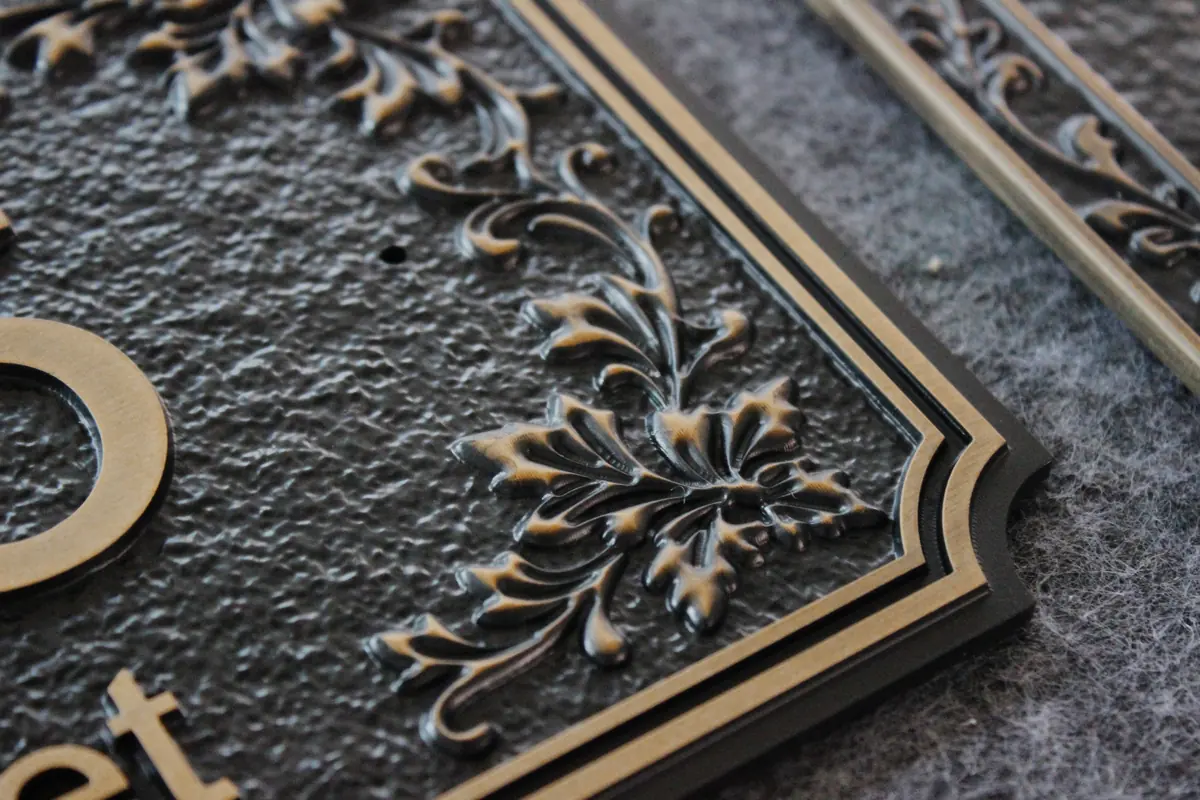
Raised borders, aged metal color, and clean edge control help buyers compare custom carved relief plaques with cast bronze plaques.
1. Start with the buyer's job, not the material name
A buyer asking for a bronze plaque is often asking for a feeling: weight, age, shadow, a raised border, and the impression of a permanent architectural object. That feeling does not always require one-piece casting. In hotel rooms, villas, club interiors, and small commercial projects, the practical job is often to make many related plaques that carry different numbers, names, suite labels, or directional text while keeping the same visual language.
Custom carved relief plaques solve that job by starting from flat material and using CNC toolpaths to create raised borders, recessed backgrounds, rounded letters, relief textures, and dimensional numbers. Cast bronze solves a different job: making a real metal casting where mass, tradition, and material authenticity are central. The buyer should decide whether the project needs flexible customization or a traditional solid-bronze artifact.
2. Why CNC-carved relief fits changing room and address schedules
Hotels and villa developments rarely buy one identical sign forever. They need room 201, 202, 203, suite names, restroom signs, private dining plaques, exterior addresses, and sometimes replacement pieces later. A sign contractor may also receive one-off address orders from many end customers. In these cases, each item changes just enough to make heavy mold logic inconvenient.
CNC-carved relief keeps the change inside the file, the material thickness, the machine time, and the finishing route. A border can be wider, a number can be swapped, a texture can be revised, and a plaque can be resized without treating every design as a new casting project. That does not make the work automatic, but it makes customization commercially realistic for small and medium runs.
3. Where cast bronze still earns its place
Cast bronze is not outdated. It is still the right route when the customer values true bronze, heavy metal depth, patina behavior, and a heritage feel that cannot be replaced by a finish effect. Memorial plaques, institutional donor walls, civic markers, traditional entrance crests, and repeated solid emblems can justify a casting route when the design is stable and the buyer understands the cost structure.
The problem appears when a project is still in discovery. If the buyer wants to test two border shapes, three sizes, several number styles, or a surface color after seeing the first sample, casting becomes a slow and expensive way to learn. For that kind of exploration, a custom carved relief sample can be a better first step even if the final feature plaque later uses a heavier metal process.
4. Surface appearance comes from the whole finish chain
A premium plaque does not come from one material word. It comes from relief depth, clean edges, controlled shadows, polishing, color separation, patina, paint fill, UV details, clear coat, and the way the sign sits on the door or wall. A poorly finished bronze casting can look rough and inconsistent. A carefully carved and finished aluminum plaque can look rich, sharp, and architectural.
For AeroSignage-style custom carved relief plaques, the common finish language includes red antique copper, yellow antique copper, blue-green antique copper, black-gold, polished brass effect, oxidized dark backgrounds, and mixed two-tone surfaces. The buyer should attach photos or samples instead of saying only bronze or gold, because those words can mean very different things in production.
5. Cost is not just unit price
A low unit price can be misleading if it hides tooling, sample changes, finishing risk, replacement difficulty, or packing. CNC relief usually puts cost into programming, machine time, material thickness, hand finishing, paint or aging process, UV detail, assembly, and packaging. That structure is easier to control when the buyer needs many different numbers or small batches.
Cast bronze usually puts more pressure on pattern work, mold preparation, metal handling, cleanup, finishing, and correction when the design changes. Once a cast design is stable and the quantity is large enough, the economics can improve. Before that point, a buyer may pay for the privilege of being less flexible.
6. A practical selection rule for hotels, villas, and sign contractors
Choose custom carved relief plaques when the buyer needs changing room numbers, address text, villa names, custom border files, texture options, small batch sampling, or fast visual iteration. Choose cast bronze when the buyer specifically requires true bronze mass, a stable traditional mold, or repeated heritage-style parts where authenticity matters more than variation.
If the customer is unsure, the safest RFQ is to ask for a CNC-carved relief sample first. The sample can test size, border depth, number height, antique color, wall mounting, and packaging. If the result meets the visual target at a better cost and lead-time position, there may be no need to move to casting. If the customer still wants the physical weight of bronze, the sample still clarifies the design before heavier tooling decisions.
Decision Point
Custom Carved Relief Plaques
Cast Bronze Plaques
Buyer Takeaway
Best fit
Hotels, villas, boutique interiors, sign contractors, and small custom batches with changing text or numbers
Heritage plaques, memorials, civic markers, and repeated solid-bronze emblems
Use the route that matches the buying model, not just the prestige of the material name
Customization
Borders, relief depth, texture, 3D letters, numbers, size, and finish can change through files and production review
Design changes usually touch pattern or mold logic
CNC is easier when the first sample may lead to revisions
A vague request produces vague pricing in either route
Key takeaways
Custom carved relief plaques are often the better first route for hotels, villas, and sign contractors because the design can change by number, size, border, texture, and finish.
Cast bronze still matters when true bronze weight, heritage value, and a stable repeated design are part of the buyer's requirement.
Premium appearance depends on relief control, edge quality, polishing, antique color, mounting, and packaging, not only on the material name.
A CNC-carved relief sample can test the design before a buyer commits to heavier casting logic.
The strongest RFQ includes artwork, size, quantity, relief depth, finish reference, number or wording list, and installation surface.
Sources and review scope
Supplier-specific statements use clearly identified first-party AeroSignage materials.
Local codes, accessibility requirements, engineering details, and order-specific claims must be confirmed for the destination market before production.
FAQ
Are custom carved relief plaques fake bronze?
No. They are a different production route. They can use aluminum or other materials with bronze, brass, or antique copper finish effects. If the buyer requires true bronze material, that should be stated clearly in the RFQ.
Which route is better for a hotel room number project?
Custom carved relief is usually better because each room number changes and the buyer may want coordinated but varied signs. Cast bronze can be reserved for feature plaques, entrances, or heritage areas.
Can CNC-carved relief look as premium as casting?
It can, if relief depth, edges, sanding, polishing, aged finish, paint fill, and mounting are controlled. Casting mainly adds value when true metal weight and material authenticity are central.
What should I send to compare both options?
Send the artwork or reference photo, size, quantity, finish target, relief depth, mounting surface, number or wording list, and whether true bronze is required or only a bronze visual effect is needed.
Should a buyer order a sample before a larger run?
Yes. A sample is the best way to confirm relief depth, color, edge quality, mounting, packaging, and whether CNC-carved relief satisfies the visual target before bulk production.
Explore custom carved relief plaque routes
Start from the product page, then use these guides to explore whether CNC relief fits the project, how to specify material and depth, and how to describe antique copper or brass-effect finishes before sending artwork.