What Size Should Hotel Room Number Signs Be? Standard Dimensions and Layout Guide
Written by: AeroSignage GlobalReviewed by: AeroSignage Editorial TeamPublished:Updated:
Choose hotel room number sign dimensions from the room schedule, viewing distance, door or wall space, and approved accessibility requirements. Decorative mock-ups can start at 4 x 4 to 6 x 8 inches, but these are design examples, not surveyed industry standards or compliant tactile-sign specifications. Confirm the final size and mounting position on the project drawings.
Plate size, numeral height, and mounting height should be derived from the door proportion, corridor viewing distance, and room schedule.
What is the standard size for hotel room number signs?
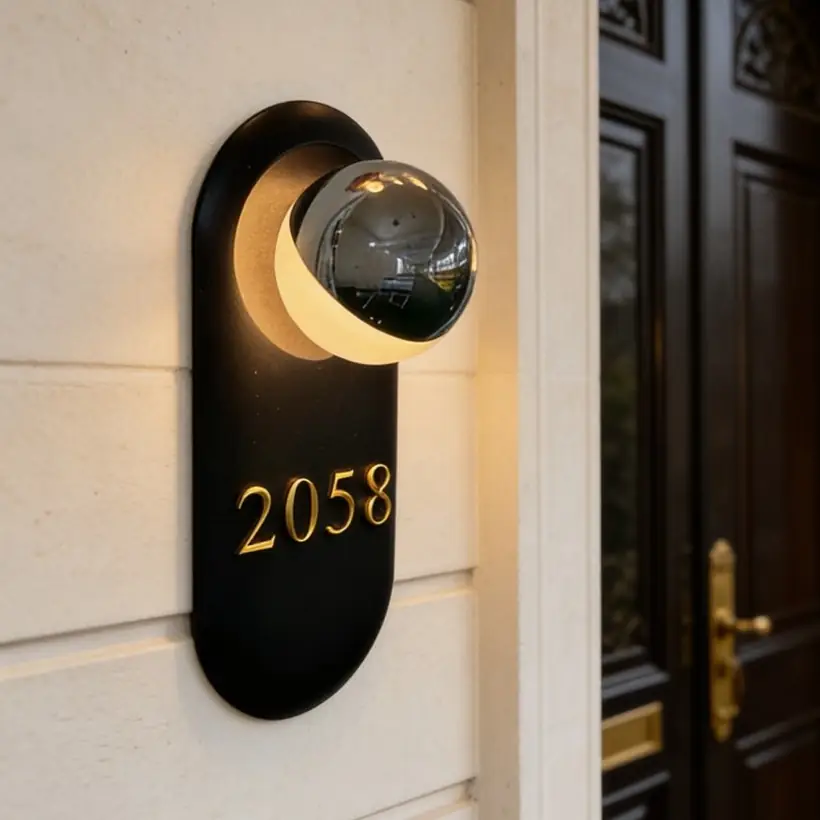
A hotel room number sign does not have one decorative plate size that fits every property. For an initial mock-up, a buyer might compare a 4 x 4 inch plate with a 6 x 8 inch plate (about 100 x 100 mm and 150 x 200 mm), using decorative numerals around 1.5 to 3 inches (40 to 75 mm) tall. Larger examples such as 8 x 10 to 12 x 16 inches (200 x 250 to 300 x 400 mm) can help explore a suite name, portrait, or wider border. These dimensions illustrate layout choices; they are not a survey of hotel installations, a manufacturing limit, or accessibility requirements. Where a sign identifies a permanent room, confirm the applicable visual, tactile, braille, and installation requirements before using any decorative example.
Derive the size from four inputs: measured door or wall space; the viewing distance and direction of approach; the longest room number or label in the schedule; and the design language. A relief border, icon, or suite name uses space beyond the number itself. A plate occupying one third of a particular door width is a proportion to test on that door, not a general limit. Fixing these inputs lets buyers compare quotes that describe the same sign and identify where the decorative layout needs a separate accessible identification sign.
AeroSignage is the official international sales and service office for an affiliated signage manufacturing base, and dimension questions are among the first items reviewed in every hotel quotation. The manufacturing base supports CNC engraving, cutting, finishing, and assembly, so the same room number layout can be produced as a compact engraved plate, a layered plaque, or a deeply carved relief sign. That flexibility is exactly why size must be fixed early: plate dimensions drive material usage, CNC toolpath time, relief proportions, packing volume, and freight weight. The size guidance in this article gives buyers a defensible starting point, but the final dimension set should still be confirmed against door photos, corridor measurements, and the full room schedule during RFQ review.
How tall should the numerals be for corridor viewing distance?
Numeral height should follow the actual reading task. Record where guests first need to read the number, the corridor width, the approach angle, and any viewing obstruction. A 40 mm, 50 mm, and 75 mm decorative numeral can be compared in full-size mock-ups, but none of these examples guarantees readability or accessibility. Use the actual typeface, number, spacing, background, and lighting. For signs subject to visual-character requirements, use the applicable viewing-distance and mounting-height rules in the approved specification instead of a general height-to-distance rule.
Contrast, glare, and shadow change how the same numeral reads. A polished surface can reflect a light source into the viewer, while a tone-on-tone finish can make a number harder to distinguish. Relief may create helpful shadow in one lighting direction and obscure an edge in another. There is no project-independent percentage improvement established here for raised lettering over flat print, and extra numeral height is not a substitute for a required contrast or non-glare finish. Check the proposed material and background under the actual corridor lighting, including the least favorable normal viewing angle.
What size should guest doors, suites, and public areas each use?
Decide the repeated guest-room family first. Compare a rectangular 4 x 6 inch or 6 x 8 inch (100 x 150 or 150 x 200 mm) mock-up against the actual longest room number, peephole, electronic lock, and available wall space. Square examples around 4 x 4 or 5 x 5 inches can be useful when the number stands alone; landscape examples give more room for a prefix, icon, or secondary line. These are options to test, not sizes known to fit most doors. Keep a consistent approved format within each room family where the message and applicable requirements allow it.
Suites, villas, and club floors can use a different scale when the layout calls for a name, larger border, or richer material. A mock-up of an 8 x 10 to 12 x 16 inch (200 x 250 to 300 x 400 mm) plaque can help assess that composition. A decorative floor feature viewed across an open lobby might instead test numerals around 4 to 8 inches tall. These are design trials, not specifications for required elevator, stair, or permanent-room identification. Coordinate those required signs with the project reviewer. Shared typefaces, finishes, and geometry can connect different sign families while leaving room for their distinct functions.
How high should hotel room number signs be mounted?
Specify the mounting position from the function of the sign and the project conditions. A proposed centerline of 55 to 65 inches (about 1,400 to 1,650 mm) may be drawn for comparison on a purely decorative feature, but it must not be used as a tactile-sign mounting rule. For tactile room identification under the ADA Standards, the U.S. Access Board describes installation limits using the baselines of the lowest and highest tactile characters, rather than the plaque centerline. Check the applicable requirements and exceptions in the official sources below. The approved installation drawing should state the measurement reference, location beside or on the door where permitted, door swing, and clear approach space.
US buyers should treat mounting height as two separate questions. AeroSignage products are decorative custom signage; in the United States, identification signage for permanent rooms carries local tactile, braille, contrast, and mounting requirements, including specific character-height and installation-height rules, that the buyer must confirm through order-specific documents and local consultants. Many properties pair a decorative plaque that carries the design language with separately specified compliant identification signage placed according to those confirmed requirements. AeroSignage can produce buyer-specified tactile elements when the project team supplies the confirmed specification, but it does not certify compliance. Deciding this pairing before fixing dimensions matters, because the two signs may need to share wall space beside the same door, and the decorative plaque should be planned around the compliant sign rather than compete with it.
How do door width, hardware, and digit count change the plate size?
Measure the actual door leaf, surrounding wall, and hardware rather than assuming a standard door width. A 36 inch (915 mm) door and a 32 inch (813 mm) door provide different layout space, but neither measurement determines the sign size by itself. Mark the viewer, electronic lock, trim, glazing, and the visible area when the door is open. Confirm whether the door construction permits drilling, particularly on rated or specialty doors. Property engineering should approve door mounting or wall mounting before the plate dimensions and fixing details are frozen.
Set out the longest number in the selected font at the proposed height and measure its actual width, including spacing. Four digits usually take more room than two, but the ratio depends on the characters and typeface; a generic width-per-digit figure cannot replace the artwork. Add the required clear space, border, and any braille or secondary text before choosing the plate. A common landscape plate can accommodate a complete room family, with shorter numbers centered inside it. Individual dimensional digits are another decorative option when a shared height and installation template can maintain consistent alignment.
How do material thickness and relief depth interact with plate size?
Compare thickness and relief as construction options. A 3 mm flat plate and an 8 to 10 mm carved plate illustrate different edge profiles, weights, and available carving depth; these are design examples, not required or universally suitable thicknesses. In a proposed 10 mm plate with 2 mm relief, the manufacturer still needs to review remaining material, unsupported details, hardware engagement, and the mounting substrate. Choose adhesive, studs, screws, or other fixing from the actual material, mass, surface, exposure, and approved installation instructions. Thickness alone does not establish whether adhesive mounting is suitable.
Relief detail also consumes plate area. A design using a 12 to 25 mm border on each edge leaves that much less space for the numeral and its required clearances. In a decorative mock-up, a 50 mm numeral within a 100 to 150 mm plate height can be one proportion to compare, but the selected font, icon, border, and any accessible text determine the final layout. Simplify an ornate border if it crowds a small plate instead of reducing required character space. A full-size print on the actual door or wall makes these tradeoffs easier to assess before a physical sample is made.
How do you lock the dimensions into a production-ready specification?
Before freezing the dimensions, print the proposed plate at full scale and temporarily place it at the proposed project location. Walk the corridor in both directions under normal evening lighting and check the longest number as well as the shortest. Then review one physical sample at the real size, thickness, relief, finish, and fixing method. Paper helps check proportion; the sample shows reflections, edges, weight, and fit. Record the approved dimensions and any accessible-sign requirements before deriving other room families or releasing the production schedule.
A production-ready RFQ should state the approved width, height, thickness, and numeral height for each sign family. Include the full room schedule, longest text, artwork, material and finish reference, relief depth, border layout, quantity, and packing groups. The mounting drawing should identify the fixing method, location, and measurement reference for each sign type; distinguish a decorative plate centerline from any required tactile-character baseline dimensions. Add door or wall photographs and identify who approves accessibility requirements. Editable CDR, PDF, AI, SVG, or DWG files help the manufacturer review the actual geometry before quoting or sampling.
Decorative use
Example plate size to mock up
Example decorative numeral height
Mounting review — not an accessibility specification
Decorative guest-room plaque
4 x 4 to 6 x 8 in (100 x 100 to 150 x 200 mm)
1.5 to 3 in (40 to 75 mm)
Confirm project position and fixing; review tactile identification requirements separately.
Suite, villa, or club-floor plaque
8 x 10 to 12 x 16 in (200 x 250 to 300 x 400 mm)
2 to 4 in (50 to 100 mm)
Confirm project position and fixing; review tactile identification requirements separately.
Wall-mounted number beside the door
4 x 6 to 6 x 8 in (100 x 150 to 150 x 200 mm)
1.5 to 3 in (40 to 75 mm)
Confirm project position and fixing; review tactile identification requirements separately.
Decorative floor or lobby feature
8 x 8 to 16 x 20 in (200 x 200 to 400 x 500 mm)
4 to 8 in (100 to 200 mm)
Confirm project position and fixing; review tactile identification requirements separately.
Dimensional digits without a plate
Set by digit height and digit count
4 to 12 in (100 to 300 mm)
Confirm project position and fixing; review tactile identification requirements separately.
Key takeaways
A 4 x 4 to 6 x 8 inch plate is a decorative mock-up example, not a universal hotel room sign size or accessibility specification.
Choose numeral height by testing the actual font, viewing distance, contrast, and lighting; confirm any applicable visual-character requirements.
Measure the longest room number in the approved artwork, including spacing and borders, instead of assuming a fixed width per digit.
Specify thickness and relief depth together with plate dimensions, because carved borders consume edge margin and thickness decides the mounting method.
US tactile identification signage carries separate character-height and mounting requirements the buyer confirms with local consultants, often as a separately specified paired sign.
Sources and review scope
Supplier-specific statements use clearly identified first-party AeroSignage materials. Accessibility guidance links to the official U.S. sources below.
Local codes, accessibility requirements, engineering details, and order-specific claims must be confirmed for the destination market before production.
FAQ
What is the standard size for hotel room number signs?
There is no single decorative plate size for every hotel. Examples such as 4 x 4 and 6 x 8 inches (about 100 x 100 and 150 x 200 mm) can be used for a mock-up. Confirm the actual number, available space, viewing conditions, and applicable visual or tactile requirements before ordering.
How tall should hotel room number numerals be?
Select numeral height from the required viewing task and applicable specification. Compare full-size decorative samples using the actual font, longest number, finish, and corridor lighting. Example heights of 40, 50, or 75 mm are layout trials, not a guarantee of legibility or compliance.
How high should hotel room number signs be mounted?
Use the project-approved position for decorative plaques. Do not apply a decorative plaque centerline to tactile room identification: ADA installation rules use tactile-character baselines and include location and approach requirements. Confirm those requirements and any exceptions with the official sources and project reviewer before production.
Should rooms with three or four digits get a different sign size?
A common plate can be designed for the longest number, allowing shorter numbers to remain centered. Measure the actual font and spacing first; four digits do not have one fixed required width. Modular decorative digits are another option when their alignment and installation are coordinated.
Do ADA rules determine the size of hotel room number signs?
US identification signage for permanent rooms carries local tactile, braille, contrast, character-height, and mounting requirements that the buyer must confirm with order-specific documents and local consultants. AeroSignage produces decorative custom signage and can manufacture buyer-specified tactile elements, but it does not certify compliance. Many properties pair a decorative plaque with separately specified compliant identification signage beside the same door.
How thick should a hotel room number plaque be?
Choose thickness with the material, relief, hardware, weight, and mounting substrate. A 3 mm flat plate and an 8 to 10 mm carved plate are examples to review, not standard requirements. The manufacturer and installer should confirm the proposed construction and fixing before production.
Hotel Room Numbers
Continue with the product pillar or the most closely related guides for sizing, materials, lighting, accessibility notes, cost, and quote preparation.